Saturday, February 4, 2012

Saint Denis, a Cephalophore

Today's Cathedral lecture was about the Saint-Denis Cathedral which is considered the first Gothic Cathedral. It was designed by the abbot, Abbot Suger. The story of Saint Denis was really interesting.


Saint Denis lived in the 3rd century and, along with two companions, was converting a lot of people to Christianity. Somewhere around 250 AD, he and his two friends were beheaded on Mons Martis. Because of the martyrdom of these saints, the hill is now known as Montmartre, "the mountain of the martyr."

After being beheaded, it is said that Saint Denis picked up his head and carried it approximately 6 miles, preaching as he walked. He stopped at the location where the Saint-Denis Cathedral now stands.

There are actually quite a few saints who are said to have been able to walk and carry their own heads after being beheaded. The term for this is "cephalophore", or head-carrier. Often, in art, the saint is shown holding his or her head and the halo, the sign of saints, is shown where their head used to be. (Photo credit: Wikipedia. Photo of Notre Dame Cathedral in Paris.)

I thoroughly enjoyed this post about cephalophores on Elizabeth Lunday's blog: My New Favorite Word: Cephalophore.

Saint-Denis

This morning I watched Lecture #5 of Professor Cook's "The Cathedral."  This one was titled Saint-Denis and the Beginning of the Gothic Style. Wow!!! This was (another) incredible lecture! And, as often happens, it inspired me to dig more.

First of all, Saint-Denis is a Gothic Cathedral in what is now a suburb of Paris. The Gothic parts, the front (entry) and back (apse), were built around 1140 AD while the center part (nave) was built about 100 years later.

Saint Denis, the person, was the first bishop of Paris and the patron saint of France. Saint Denis was martyred and buried at this location in about 250 AD. This site became a popular pilgrimage site and a chapel was erected here around 475 AD. This chapel was turned into a royal monastery and most of the kings of France were buried here until the time of the French Revolution. During the revolution, the bodies of the kings were removed and buried in a mass grave. Later, the bodies were dug up and reburied in a common ossuary (a place where skeletal remains are buried).

Abbott Suger was the abbot of Saint-Denis from 1122-1151 AD. He was a friend and advisor of Kings Louis VI and Louis VII. He served as a regeant of the kingdom during the Second Crusade. The cathedral was dilapidated, and Suger wanted to rebuild it to rival the temple of Solomon! Abbot Suger is the man often credited as starting the Gothic style of architecture.

Wednesday, February 1, 2012

What is a Cathedral?

As I prepare for our trip to Europe, I have now finished my first Great Courses lecture series by William Kloss, World's Greatest Paintings. This morning, I started a new series, this one by Professor William R Cook, entitled The Cathedral. The first lecture was titled What is a cathedral? This is what I learned...
After the 1st century, when Jesus' apostles had all died, each community started having a local bishop who had authority in his region. These were small groups who often met either in secret or quietly because of persecution. In the fourth century, however, Roman Emperor Constantine became a Christian and he legalized Christianity. Because of this, Christianity grew rapidly and the Christians were not being persecuted. And, the church starts to accumulate wealth.

(Christ Church Cathedral in Dublin, Ireland - the only cathedral I've visited...yet!)

Each bishop, who was in charge of a region, sat in a seat called a cathedra. With larger numbers of Christians/Catholics, they erected buildings to house the cathedras, thus creating the first cathedrals. As the Roman Empire collapsed, the bishops role became larger. The people lived under "canon law" - the law of the church which was administered by the bishop sitting on his cathedra. Besides law, the bishops also had a political role since there were no Roman administrators left.
The bishops became very wealthy as the people gave gifts of land, jewels, gold, etc. Perhaps the gifts were of a pious nature, or perhaps they were trying to gain religious favor. The bishops used the wealth to create enormous cathedrals.
Relics were kept inside of the cathedrals. The relics were bones or other parts of the bodies of saints or other religious martyrs. These relics were believed to be powerful, so many people made pilgrimages to the cathedrals that housed these relics. One example is Canterbury Cathedral which housed the bones of the Holy Blissful Martyr, Saint Thomas Becket of Canterbury. This pilgrimage is the basis for Chaucer's book, The Canterbury Tales.
Why did the cathedrals need to be so big? One of the main reason was to house all of its members during feast days, which could be for the 'big' religious holidays (like Easter) or for local Saint's days. Also, baptisms were often held here. The baptisms could be collective for many babies, perhaps on a Saint's day, or could be for the child of an important family.
The cathedrals you can visit today are usually still in use and have goen through a lot of repair and remodeling. They are NOT museums. They do not look exactly like they did when they were first built. Some reasons include:
  • damage from revolutions (like the French Revolution)
  • damage from the Protestant Reformation
  • damage and abandonment by Communist governments
  • damage from wars (like WWI and WWII)
  • damage by natural disasters like fire and earthquakes
  • damage of erosion and discoloration by industrial pollution
Most of the lectures will cover Gothic Cathedrals which started in France so that will be the focus of the lectures. The term "Gothic" wasn't used until the 18th century. This style of building was considered "primitive" and representative of the superstitious medieval Catholic church. Gothic referred to the Germanic tribe of Goths so it meant they were "barbarian."

Saturday, January 7, 2012

Arlington Cemetery

I'm trying to catch up on my travel posts. This is from DC in October 2010.

We were on a tight schedule this day and our biggest mistake was not eating before we went to the cemetery! It was a long ride and we thought we'd get something at the cemetery. Well, food is not allowed at the cemetery. And, we were there for hours even though we 'hurried.' One of the girls in our group had her blood sugar crashing and her mom talked one of the employees into getting some food (from his own stash). But, the rest of us went HUNGRY.

I loved that we visited DC in fall. It was beautiful!

The Kennedy's.

We got to the changing of the guards at the Tomb of the Unknown Soldiers fairly early and sat and waited for quite awhile. But, it was a beautiful day and we had nice seats on the stairs. We didn't realize this was a day they would change the flowers so we got up and left our seats. It was disappointing that we didn't see it, but we were tired and still had a long walk ahead of us. And, one of the moms had a grave she wanted to find. We ended up going on without them. Everyone was tired & hungry.
My favorite photo of the day.

I read that the rocks on the tombstones are a Jewish way of paying respect. And, when I looked at the stones I'd taken photos of, they do have the Star of David on them, though I also saw one with a cross.

Dickens on the Strand

In December, Alex & I attended "Dickens on the Strand" for the third year in a row. This holiday festival in Galveston celebrates the Victorian London of Charles Dickens. There is a parade, food, entertainment, and a visit by the "Queen" and her Beefeaters. Also, many of the spectators dress up in period costumes.


We once again stayed at the Hilton Galveston Island Resort. We really enjoyed the hotel last year. And, this year, we got a great deal on a room with a full gulf view! On Friday night, we drove up after school and then went to dinner, also like last year, at Rainforest Cafe. Then, we went to a movie, Arthur Christmas.


The next morning, we spent some time on the beach. We took a lot of photos, and Alex found this Monarch butterfly in the water. It was still alive and we ended up putting it on some foliage.


It was a nice day and we watched some people surfing. We saw several of them actually surf!


Then, we headed to The Strand, the historic part of Galveston where the festival is held. We parked about a half a mile away and we were thrilled that there were some bicycle taxis available this year. Ours was very friendly and we were happy for the ride. He took this photo for us.


We watched quite a few street acts, including this man who juggled fire...
and hammered a nail into his nose! Gross! And, ouch!


Some Victorian beggars. The crowd was actually throwing coins for them to gather.


We love chalk art! There were only a few of these, but they are always fun to look at.


Jacob Marley from The Christmas Carol?

One of the streets act was a bird show! I love birds!


The start of the parade!


And, Queen Victorian in the parade.


Lastly, our favorite act for the third year in a row...Merrie Mary. She's a juggler and we love her!

Thursday, January 5, 2012

Kimbell Art Museum

Yesterday, we went with my mom to the Kimbell Art Museum in Fort Worth. We were specifically there to see a special exhibit, but we also looked through the permanent exhibits.

(All photos are from the Kimbell site)
Ganesh
Alex's favorite piece of art was of Ganesh, an Indian god. Alex has a new friend and I spent some time with her mom a few weeks ago. She was in India during a festival for Ganesh, a festival that Alex & her friend also learned about in school this year. This Hindu festival takes place around August or September and lasts for 10 days. Statues of the god are made, sold, decorated & worshipped. Then, the statues are led in a procession through the streets and "immersed in a river or the sea symbolizing a ritual see-off." (from Wikipedia)


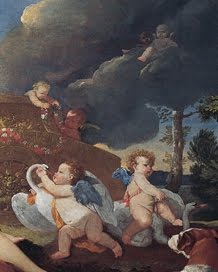
Cherubs vs Putti
In the Great Course lectures I've been watching, the lecture (Kloss) refers to putti. I wasn't sure what the difference between cherub & putti were and we came across both terms at the Kimbell. The image above (a close up of putti from Poussin's Venus & Adonis) called the cute winged babies 'putti'. Well, after doing research at home I came across this terrific blog post at Many Shades of Shabby. Basically, if the painting is religious & the babies are 'innocent', they are cherubs (like the cherubim angels of the Bible). If the painting is secular, usually mythological, and the babies are not innocent looking, they are putti.


The Sacrament of Ordination by Poussin
This painting is one of a series of 7 paintings by Poussin in the mid to late 1630's covering the 7 sacrements. Since I am not Catholic, I had to do a little reading to find out about the 7 sacraments. The Kimbell site actually gives a pretty good explanation:
1. Ordination - the taking of holy orders to become a priest, deacon or bishop - shown here as Christ giving the keys of heaven & earth to Peter.
2. Confirmation
3. The Eucharist (communion)
4. Extreme Unction (the last rites)
5. Marriage
6. Penance (confession) - this painting was destroyed in a fire
7. Baptism - which is in the National Gallery of Art in DC & we hope to see it in March.


The Torment of St Anthony by Michelangelo
This amazing painting was done by Michelangelo and is believed to be his earliest painting...at the age of only 12 or 13!!! This is the first Michelangelo to be in an American collection. And, St Anthony is one of the saints I've been reading about lately as I learn about art history. Basically, Saint Anthony became a religious hermit and was said to have been tormented by Satan. Artists have portrayed these temptations and torments with all kinds of scary, make-believe beasts.

Saint Sebastian Tended by Irene attributed to Georges de La Tour
I loved this painting of Irene tending to Saint Sebastian, another saint I've been reading about lately. Saint Sebastian was a Roman soldier under Diocletian. Diocletian ordered him executed by a firing squad of archers after Sebastian had been converting soldiers to Christianity. Irene took care of him and he miraculously lived. Though, after his recovery, he confronted Diocletian who ordered him executed...again. This time, Sebastian died. I love the gentleness of Irene in this painting.

P.S. I loved this post over at Family Ramblings that tells about a lot of the other fun things to do in Fort Worth. I'm going to have to try more of them!

Monday, January 2, 2012

Looking back at 2011 trips....and ahead to 2012!

I still have a lot of travel posts to catch up on for 2011. Our "big" trips were as follows...


1. JAPAN!!! What an amazing adventure! And, we got home just 2 days before the tsunami.

 
2. FLORIDA - We spent several days at the beach and visited Disney for the first time.
 
 
3. MONTANA/WYOMING - Where we visited the Grand Tetons, Yellowstone, and more! Our "Wild West" vacation.

What are our plans for 2012???

 
1. WASHINGTON DC - Alex & I are headed there for Spring Break. We were there about a year and a half ago, but there is a lot more we want to see!

2. TWO WEEKS IN EUROPE! We will probably spend a couple of days in London, at least a week in France, and several days in The Netherlands. All of these are 'firsts'.

3. FLORIDA & SAVANNAH, GA - We will be visiting Amelia Island in Florida and spending some time in Savanah - our first time to Georgia!