Showing posts with label art. Show all posts

Wednesday, April 11, 2012

Crystal Bridges Art Museum

This weekend, Alex & I went with my husband's aunt to see a new art museum: Crystal Bridges Museum of American Art in Bentonville, Arkansas. The museum, which opened in November, was founded by Alice Walton of the Walmart family. The museum is a nonprofit organization and admission is FREE because of a grant from Walmart.


The museum buildings are amazing and it sits on a gorgeous 120 acre site with over 3 miles of walking and biking trails. Unfortunately, it was raining, so we didn't go out on the trails.

From the site: "the Museum complex encompasses a library, the hands-on Experience Art Studio and Drop-in Studio, a glass-enclosed gathering hall for lectures, films, and other events, a Museum Store, a restaurant, and areas for outdoor concerts and public events. (Above: part of a trail and sculpture taken through large glass window.)

The collection of American art is divided into 4 sections: Colonial, 19th Century, Modern, and Contemporary. The Colonial collection included art by Gilbert Stuart (the Constable-Hamilton portrait of George Washington shown above), John Trumbull, John Singleton Copley, and Samuel Finley Breese Morse (of morse code fame and whose art I discussed here).
Trompe L'oeil by Haberle from Wikipedia
The 19th Century area includes some trompe l'oeil which is art that tricks the eye into thinking it's 3 dimensional. One piece was by Haberle, though it isn't the one I posted above. There was also work by Mary Cassatt, Augustus Saint-Gaudens, and John Singer Sargent (whose art I copied for my charcoal portraits).

Norman Rockwell's Rosie the Riveter which was on Saturday Evening Post (from Wikipedia)
The Modern and Contemporary sections included art by Norman Rockwell (one of my favorite artists!), Andy Warhol, Jasper Johns (who we studied here), Louise Nevelson (who we studied here), and Jacob Lawrence.

I loved the layout of the museum. There were two places where you could stop and rest and look at art books or get on iPads to learn more about the art. And, there were two hands-on activity centers. Unfortunately, one closed just as we found it. But, we spent some time in the other. It had quite a few activities (including a dressing up area and places to build and to learn about art). Alex and Aunt C had fun making butterfly art!

Saturday, February 4, 2012

Saint Denis, a Cephalophore

Today's Cathedral lecture was about the Saint-Denis Cathedral which is considered the first Gothic Cathedral. It was designed by the abbot, Abbot Suger. The story of Saint Denis was really interesting.


Saint Denis lived in the 3rd century and, along with two companions, was converting a lot of people to Christianity. Somewhere around 250 AD, he and his two friends were beheaded on Mons Martis. Because of the martyrdom of these saints, the hill is now known as Montmartre, "the mountain of the martyr."

After being beheaded, it is said that Saint Denis picked up his head and carried it approximately 6 miles, preaching as he walked. He stopped at the location where the Saint-Denis Cathedral now stands.

There are actually quite a few saints who are said to have been able to walk and carry their own heads after being beheaded. The term for this is "cephalophore", or head-carrier. Often, in art, the saint is shown holding his or her head and the halo, the sign of saints, is shown where their head used to be. (Photo credit: Wikipedia. Photo of Notre Dame Cathedral in Paris.)

I thoroughly enjoyed this post about cephalophores on Elizabeth Lunday's blog: My New Favorite Word: Cephalophore.

Thursday, January 5, 2012

Kimbell Art Museum

Yesterday, we went with my mom to the Kimbell Art Museum in Fort Worth. We were specifically there to see a special exhibit, but we also looked through the permanent exhibits.

(All photos are from the Kimbell site)
Ganesh
Alex's favorite piece of art was of Ganesh, an Indian god. Alex has a new friend and I spent some time with her mom a few weeks ago. She was in India during a festival for Ganesh, a festival that Alex & her friend also learned about in school this year. This Hindu festival takes place around August or September and lasts for 10 days. Statues of the god are made, sold, decorated & worshipped. Then, the statues are led in a procession through the streets and "immersed in a river or the sea symbolizing a ritual see-off." (from Wikipedia)


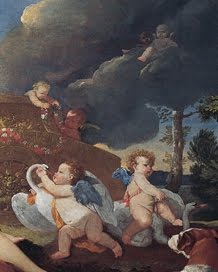
Cherubs vs Putti
In the Great Course lectures I've been watching, the lecture (Kloss) refers to putti. I wasn't sure what the difference between cherub & putti were and we came across both terms at the Kimbell. The image above (a close up of putti from Poussin's Venus & Adonis) called the cute winged babies 'putti'. Well, after doing research at home I came across this terrific blog post at Many Shades of Shabby. Basically, if the painting is religious & the babies are 'innocent', they are cherubs (like the cherubim angels of the Bible). If the painting is secular, usually mythological, and the babies are not innocent looking, they are putti.


The Sacrament of Ordination by Poussin
This painting is one of a series of 7 paintings by Poussin in the mid to late 1630's covering the 7 sacrements. Since I am not Catholic, I had to do a little reading to find out about the 7 sacraments. The Kimbell site actually gives a pretty good explanation:
1. Ordination - the taking of holy orders to become a priest, deacon or bishop - shown here as Christ giving the keys of heaven & earth to Peter.
2. Confirmation
3. The Eucharist (communion)
4. Extreme Unction (the last rites)
5. Marriage
6. Penance (confession) - this painting was destroyed in a fire
7. Baptism - which is in the National Gallery of Art in DC & we hope to see it in March.


The Torment of St Anthony by Michelangelo
This amazing painting was done by Michelangelo and is believed to be his earliest painting...at the age of only 12 or 13!!! This is the first Michelangelo to be in an American collection. And, St Anthony is one of the saints I've been reading about lately as I learn about art history. Basically, Saint Anthony became a religious hermit and was said to have been tormented by Satan. Artists have portrayed these temptations and torments with all kinds of scary, make-believe beasts.

Saint Sebastian Tended by Irene attributed to Georges de La Tour
I loved this painting of Irene tending to Saint Sebastian, another saint I've been reading about lately. Saint Sebastian was a Roman soldier under Diocletian. Diocletian ordered him executed by a firing squad of archers after Sebastian had been converting soldiers to Christianity. Irene took care of him and he miraculously lived. Though, after his recovery, he confronted Diocletian who ordered him executed...again. This time, Sebastian died. I love the gentleness of Irene in this painting.

P.S. I loved this post over at Family Ramblings that tells about a lot of the other fun things to do in Fort Worth. I'm going to have to try more of them!

Wednesday, December 7, 2011

Samuel F B Morse - Inventor & Artist

As I've been debating on where to go over Spring Break with Alex, one of my thoughts was a return trip to Washington DC! We both loved it, we were comfortable getting around on our own, and there is so much more to see! One place we didn't see was the National Gallery of Art, and they currently have a special exhibition of Morse's painting, The Best of the Louvre.


We studied Morse way back in 2006, but the books we read about him only covered the telegraph. I hadn't realized that he was a painter before an inventor - or if I'd read that fact, I'd forgotten it. He was also a Christian who described his life work by saying, "'It is His work. “Not unto us, but to Thy Name, O Lord, be all the praise.” (Answers in Genesis has a great article about him here.)

The painting, The Best of the Louvre, showcases many pieces of art that were actually in the Louvre though they were not all in the same room. (Can you find the Mona Lisa?) In the center of the the painting you can see Morse looking over the shoulder of his daughter who is painting. Also pictured, in the left, is his friend and author, James Fenimore Cooper pictured with Cooper's wife and daughter.

In an interview with NPR's Susan Stamberg, author David McCullough said, ""It was an extremely ambitious undertaking because many of the paintings that he was copying were hung very high up. And so he had to build a movable platform, or scaffold, that he wheeled about the galleries of the Louvre to reach his subjects. And he and the movable scaffold became a tourist attraction themselves"

As to why the painting was created, David McCullough said, "There were no museums here, as yet, in the 1830s, and no color representations of paintings, so he was going to bring the culture of Europe — mainly the Renaissance Italian masterpieces in the Louvre collection — back to the United States for the benefit of his countrymen." (Quotes from the NPR site.)

As we also look forward to our trip to France this summer, I am really enjoying this painting! And, I'm looking forward to reading McCullough's new book, The Greater Journey: Americans in Paris. It is the story of Americans, from the year 1830 to 1900, who went to Paris to excel in their work - whether they were artists, authors, doctors, politians, etc.

P.S. Another great site about Morse and his art is found at the Terra Foundation for American Art website. www.terraamericanart.org under "collections".

Monday, November 30, 2009

How We Prepared for NYC

I try to prepare for our vacations by reading information about places we might see and visit. I should have posted this a long time ago, but here are some of the resources we used while getting ready for NYC:
I'm busy planning for a trip or two this spring. I'll let you know soon where we're going!

Saturday, October 3, 2009

MoMA Collection Online... and Our Next Trip...


We will be headed on our next trip soon... to New York City! One of our stops will be the Museum of Modern Art. Today, I was doing some research on some of the artists and pieces of art work that we'll see and I came across a link to MoMA on Barb's blog. I am using the site to print out some of the artwork we'll see and I'll be making a matching game.


But, YOU might enjoy this MoMA site to review art on your own! (I enjoyed 'testing' myself to see how much I've learned the past few years... I did pretty good! I'll be testing Alex next week.) You can go to the "Browse the Collection Online" section  and use the "browse filter" button to select "highlights." This button shows some of their most famous pieces of art! (Note: You might want to browse this site without your child as you never know what you'll come across!) You can also create your own account and make your own set of "collected works." This is what I'll be showing Alex instead of risking running into something I'd rather her not see. I think this would be a great review for anyone who has been studying artists.

(Photos are of 2 projects we did in the past relating to artists at MoMA: Jasper Johns and Picasso. Other artists we've studied that we hope to see artwork by include: Warhol, Lichtenstein, Nevelson, and Chagall.)

Saturday, September 15, 2007

Chicago - Day 4 - Art Institute

On Day 4, we spent over 6 hours at the Art Institute of Chicago - and we could have stayed much longer! (Or come back a second day!) We were so excited to see so many artists... and specific paintings!... that we recognized.


Alexandra took a photo of each suit of armor.


I got excited to run into a few Precissionism paintings by Demuth that I had studied just a few weeks earlier!


We saw lots of paintings by Georgia O'Keefe.


American Gothic by Grant Wood - I'd always thought this was a farmer and his wife, but it is a farmer and his daughter!


Alexandra looking at one of the miniature room displays - there were probably 50 or so and they were so small and detailed! We both love miniatures.


I was excited to recognize this as a painting by Thomas Cole, Father of the Hudson River School of Art I also studied recently. And, my mom could even remember his 5 components of art I'd shared with her. He thought each piece of art should have: still water, a water feature, mountains, sky, and trees. (This is from memory - I'll have to look at my notes to make sure I got it right.)


Alexandra in front of Mary Cassatt's The Child's Bath - one of our favorites! We stayed in front of this one quite a while.


Alexandra (and I!) got so excited to see this one. It is one of Picasso's paintings of Sylvette, "The Girl with the Ponytail." This one was titled Portrait of Sylvette David. We came to love this painting by reading the book Picasso and the Girl with the Ponytail by Laurence Anholt. Great book and great story!


A painting by Picasso we see in books - Mother and Child.


This painting is called Rainy Street by Caillebotte. I took it because it was on the cover of a brochure Alexandra was carrying around. We bought the tour book and Alexandra loved looking through it and finding paintings that were in her book. It was like a scavanger or treasure hunt!


Another one Alexandra got very excited about since we'd studied it. This one is Acrobats at the Cirque Fernando by Renoir.


Another Picasso (who we're currently studying) from his Blue Period - The Old Guitarist.


Another example of Seurat's Pointilism which Alexandra was thrilled to recognize - Bathers at Asnieres.


Another we recognized - Van Gogh's Self Portrait.


And another we recognized - Bedroom in Arles by Van Gogh.


LOTS of Monet's!!!

And, a highlight was seeing Seurat's large painting, Sunday afternoon on La Grande Jatte. My mother has memories of seeing this painting when she was a little girl, and I hope Alexandra always remembers this special day when we saw so many incredible pieces of art!